
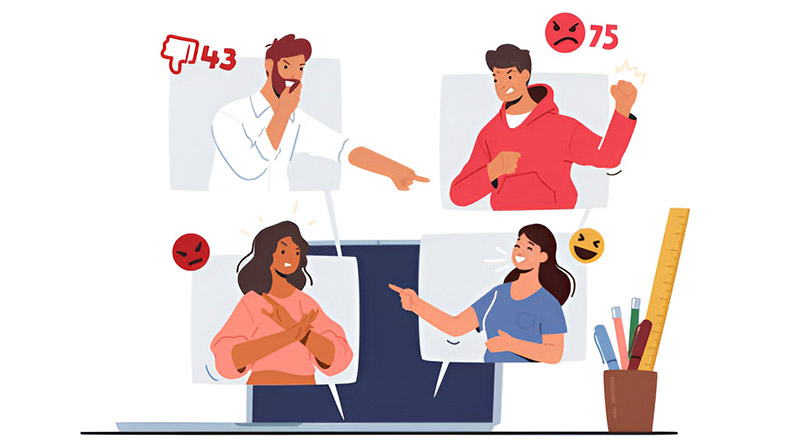
Every day, millions of people log into Discord servers, Reddit forums, Facebook groups, and countless other digital spaces where personalities collide and opinions diverge. The question isn’t whether conflict will occur—it’s whether that conflict will strengthen the community or tear it apart.
Online communities thrive on engagement, but there’s a razor-thin line between productive disagreement and destructive drama. According to Pew Research Center data from 2024, 68% of social media-using teens have witnessed people stirring up drama on these platforms, with girls more likely than boys to encounter this phenomenon. Meanwhile, research shows that when managed properly, workplace and community disagreements can drive innovation and creative problem-solving.
Understanding the difference between healthy conflict and toxic drama has become essential for anyone building, moderating, or participating in online spaces. This article explores both sides of this digital coin, examining when friction fuels growth and when it becomes poison.
The Nature of Online Conflict: Understanding “Drama”
Researchers have identified a distinct phenomenon in digital spaces that participants—particularly younger users—call “drama.” Unlike straightforward disagreements, drama involves performative, interpersonal conflict that plays out before an active, engaged audience.
According to a 2014 study on teen perspectives in networked environments, drama serves as an emergent concept describing conflicts that teens find less stigmatizing than terms like “bullying” or “harassment.” The key distinction lies in the spectacle: drama requires an audience and often involves exaggerated emotions, public call-outs, and extended back-and-forth exchanges.
The Amplification Effect
Social media platforms function as stages where conflicts can quickly escalate beyond their original scope. What might start as a minor disagreement between two users can balloon into a community-wide event as others join in, take sides, or simply spectate.
Platform-specific features amplify drama in unique ways. Discord, with its 200 million monthly users as of 2024, employs user-driven moderation that can either contain or exacerbate conflicts depending on how communities are managed. Reddit’s upvote/downvote system can turn disagreements into visibility contests where the most inflammatory comments rise to the top.
The data on Discord from the first half of 2024 reveals the scale of moderation challenges: users submitted over 15 million reports for platform manipulation and approximately 5.59 million reports for harassment and bullying. These statistics underscore how prevalent conflict has become across digital platforms.
When Conflict Becomes Healthy: The Productive Side
Not all conflict is created equal. Research from organizational psychology demonstrates that properly managed disagreement can actually strengthen communities and drive better outcomes.
The Innovation Catalyst
Studies conducted by Cornell’s Professor Elizabeth Mannix on conflict management reveal that high-performing teams often experience significant conflict—the difference lies in how they navigate it. Teams that establish clear rules for disagreement while staying focused on their mission achieve both high performance and high satisfaction.
Harvard researchers Julia Minson and Francesca Gino found that “disagreement, when managed well, gets greater results than avoidance does.” Their research demonstrates that organizations fostering debate cultures alongside collaboration and trust can transform potentially destructive conflicts into productive ones.
Characteristics of Healthy Conflict
Productive disagreements in online communities share several key traits:
- Respect for diverse perspectives: Participants acknowledge that different viewpoints have value, even when they disagree
- Focus on ideas, not individuals: Arguments center on concepts and solutions rather than personal attacks
- Evidence-based reasoning: Participants support their positions with data, examples, and logical arguments
- Willingness to change minds: What psychologists call “intellectual humility” allows people to evolve their thinking
- Clear community guidelines: Well-defined rules help members understand boundaries for acceptable debate
According to a 2024 Slack survey, 80% of workers want more trust and transparency in the workplace, and 91% want to feel closer to their colleagues. The same principles apply to online communities—transparent norms around disagreement help members feel safe expressing contrasting opinions.
Real-World Examples of Productive Conflict
Online debate platforms like Kialo demonstrate how structured conflict can foster learning. Distributed moderator teams vet and organize pro/con arguments on complex topics ranging from internet neutrality to climate change. Research on these platforms shows that when personal stakes are made visible and conflicts are managed through clear processes, communities can handle even adversarial beliefs productively.
Stack Exchange communities have thrived for years by channeling disagreement into constructive technical discussions. Their voting systems and moderation frameworks transform potential arguments into collaborative problem-solving sessions where the best solutions rise through community consensus.
When Drama Turns Toxic: The Dark Side of Online Conflict
While healthy conflict can strengthen communities, toxic drama extracts a heavy price. The transition from productive to destructive happens when conflicts become personal, persistent, or performative beyond their substantive value.
The Cyberbullying Crisis
According to the Cyberbullying Research Center’s 2025 tracking data, online harassment has surged dramatically:
- Lifetime victimization rose from 33.6% in 2016 to 58.2% in 2025
- 30-day victimization increased from 16.5% in 2016 to 32.7% in 2025
- Offending behavior jumped from 5-6% between 2015-2021 to 16.1% in 2025
These aren’t merely statistics—they represent real psychological harm. Research published in the Journal of Medical Internet Research in 2025 examined the “pericyberbullying period” and found that victims experienced significant decreases in happiness, increases in suicide risk, and moral cognition disruptions in the time surrounding harassment incidents.
Mental Health Consequences
The mental health toll of toxic online interactions is severe and well-documented. A 2025 study in The Lancet Regional Health found that 93% of cyberbullying victims report negative mental health effects. Specific impacts include:
- Increased depressive symptoms and anxiety
- Suicidal ideation increasing by nearly 15% among victims
- Suicide attempt rates rising by almost 9%
- Somatic symptoms like headaches and sleep disturbances
- Social withdrawal and decreased self-esteem
According to CDC data from 2024, teens who experienced bullying reported anxiety rates of 29.8% compared to 14.5% among non-bullied peers. Depression rates followed similar patterns at 28.5% versus 12.1%.
The Platform Problem
Different platforms present unique challenges for toxic behavior. Research on platform-specific cyberbullying from 2024 found that:
- 42% of Instagram users have experienced bullying, the highest among major platforms
- Facebook users reported 37% experiencing bullying
- Gaming communities face particularly severe harassment, with 64% of online gamers experiencing mental attacks
- Social media platforms account for 65% of worldwide cyberbullying incidents
A 2025 research study on alternative platforms like Scored (a Reddit alternative) documented how banned fringe communities migrate to new platforms, often bringing toxic behaviors and extremist content with them. The study tracked approximately 57 million posts over four years, revealing patterns of radicalization and coordinated harassment campaigns.
The Moderation Challenge: Walking the Tightrope
Community moderators find themselves on the frontlines of managing the conflict-drama spectrum. Their decisions shape whether disagreements evolve productively or devolve into toxicity.
Discord’s Decentralized Model
Discord’s user-driven moderation approach offers flexibility but also challenges. A 2025 study on Discord moderation revealed that voice-based communities face unique difficulties: the ephemerality of real-time voice communication makes acquiring evidence of rule-breaking behavior extremely difficult.
Moderators report developing workaround strategies based on “hearsay and first impressions,” which can lead to unsuccessful moderation or false accusations. This highlights a critical tension: protecting community members while ensuring fair enforcement.
Best Practices for Conflict Management
Research and practical experience have identified effective strategies for community managers:
- Establish clear, specific guidelines: Ambiguous rules create confusion and disputes. Communities need explicit boundaries for acceptable behavior
- Train moderators comprehensively: Understanding roles, responsibilities, and conflict de-escalation techniques is essential
- Address conflicts early: Small tensions are easier to resolve before they escalate into community-wide drama
- Create appeals processes: Members should have ways to contest moderator decisions, promoting accountability
- Foster positive culture proactively: Don’t just punish bad behavior—actively encourage and model constructive engagement
- Use data and feedback: Track recurring issues and gather member input to improve strategies
The Moderator Burnout Factor
Constant exposure to conflict takes a toll on volunteer moderators. Communities must recognize that moderation isn’t about competition or quantity but quality. According to Discord’s own moderation guidance, creating supportive environments for mod teams—where “real life comes first”—is essential for sustainable community management.
Finding the Balance: Cultivating Healthy Online Spaces
The goal isn’t to eliminate all conflict but to channel it productively while preventing toxicity. This requires intentional design and ongoing effort from platform creators, community leaders, and individual members.
For Community Builders and Moderators
Creating spaces where healthy conflict thrives requires:
- Transparent rule-setting: Involve community members in developing guidelines they’ll follow
- Consistent enforcement: Apply rules evenly regardless of personal relationships
- Education over punishment: Help members understand why certain behaviors harm the community
- Recognition of positive contributions: Reward constructive engagement and thoughtful disagreement
- Regular reassessment: Communities evolve, and so should their conflict management approaches
For Individual Members
Participants share responsibility for community health:
- Practice intellectual humility: Be willing to change your mind when presented with better arguments
- Engage ideas, not identities: Critique positions without attacking the people holding them
- Support, don’t spectate: When witnessing harassment, report it rather than amplifying it through engagement
- Take breaks when heated: Step away from conflicts before responding emotionally
- Assume good faith: Tone is difficult to interpret online; give others the benefit of the doubt
The Role of Platform Design
Technology shapes behavior. Platforms can engineer healthier conflict through features like:
- Cooling-off periods before posting heated responses
- Highlighting constructive disagreements over inflammatory ones
- Making moderation tools more sophisticated and user-friendly
- Providing better context signals to reduce misunderstandings
- Creating separate spaces for different types of discussions
Conclusion: Conflict as Community Currency
The question isn’t whether online communities will experience conflict—they will. The critical question is what kind of conflict they’ll nurture.
Healthy disagreement drives innovation, deepens understanding, and strengthens relationships. It challenges echo chambers, surfaces better solutions, and helps communities evolve. When people feel safe expressing contrasting viewpoints, engagement flourishes and collective intelligence emerges.
Toxic drama, conversely, drives people away. It creates hostile environments where learning stops and psychological harm accumulates. The statistics are clear: with cyberbullying victimization rates nearly doubling since 2016 and affecting well over half of young people, we’re facing a crisis that demands attention.
The path forward requires collective action. Platform designers must build better tools for both expression and protection. Community leaders need training in conflict management that goes beyond simple rule enforcement. Individual members must commit to disagreeing without dehumanizing.
Most importantly, we need to recognize that conflict itself is neutral—it’s what we do with it that matters. A heated debate about the best programming language or the ethics of artificial intelligence can generate tremendous value when participants engage respectfully and substantively. The same topics can spawn toxic harassment when handled poorly.
As online communities continue growing in importance for social connection, professional networking, and civic discourse, mastering the art of productive conflict becomes not just valuable but essential. The communities that thrive will be those that can distinguish between the drama that entertains at others’ expense and the disagreement that elevates everyone involved.
The choice between healthy conflict and toxic drama ultimately reflects our values about what we want digital spaces to be: arenas for genuine discourse and growth, or stages for performative cruelty. Every community member, moderator, and platform designer makes this choice through their daily actions and decisions.
🎬 That’s a wrap! Dive into more fresh content and join the vibe at SimpCity.