

Challenging a will can feel like the right thing to do, especially when you believe the estate wasn’t divided fairly. The problem is, the risks of contesting a will are easy to underestimate until you’re already in the middle of it.
At Securator Legal, we’ve helped Queensland families work through contested estates and seen firsthand what these disputes cost, both financially and emotionally. While some claims are absolutely worth pursuing, others end up costing far more than they ever recover.
This article covers what you need to know before you decide. You’ll get a clear picture of the legal costs involved, how court processes work, the specific risks tied to family provision claims, and how to weigh up whether contesting is genuinely the right move for your situation.
What Are the Real Risks of Contesting a Will?
The major risks of contesting a will include losing your case, paying the other side’s legal costs, and disrupting the estate administration. And frankly, most people don’t find out how exposed they are until they’re already committed.
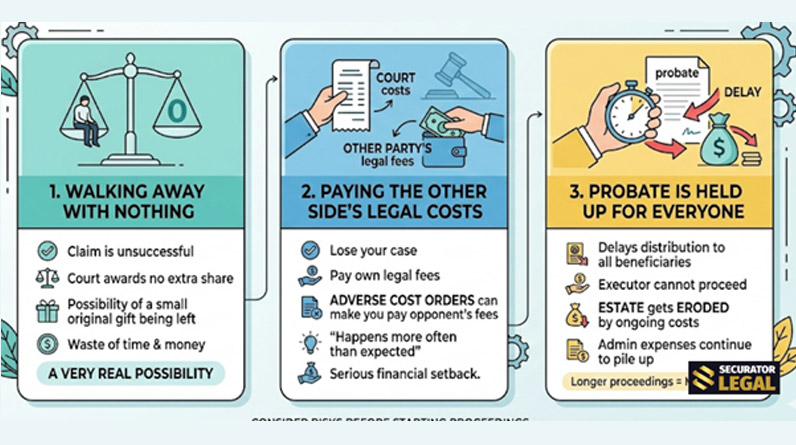
Three risks in particular tend to catch claimants off guard:
You Could Walk Away With Nothing
Contesting a will does not guarantee you a larger share of the estate.
If your claim is unsuccessful, the court will not award you anything beyond what the testator originally left you. Because contesting takes time and money, walking away with nothing is a very real possibility that every applicant needs to weigh up before starting proceedings.
You Might Pay the Other Side’s Legal Costs
Losing a will dispute in Queensland can mean paying your own legal fees and the other party’s as well (and yes, it does happen more often than people expect). Courts have discretion to make adverse cost orders against unsuccessful claimants, which can turn a difficult situation into a serious financial setback.
Probate Gets Held Up for Everyone
A contested will delays probate, which means the executor cannot distribute the estate until the dispute is resolved. The longer the proceedings run, the more the estate gets eroded by ongoing legal costs and administration expenses.
Now, let’s look at what those risks actually cost in dollar terms.
How Much Does Contesting a Will Cost in QLD?
Most people are surprised by just how expensive a will dispute can get, even before it reaches court. And the costs don’t wait for the courtroom either; as filing fees, expert reports, and barrister appearances all start adding up well before a hearing date is even set.
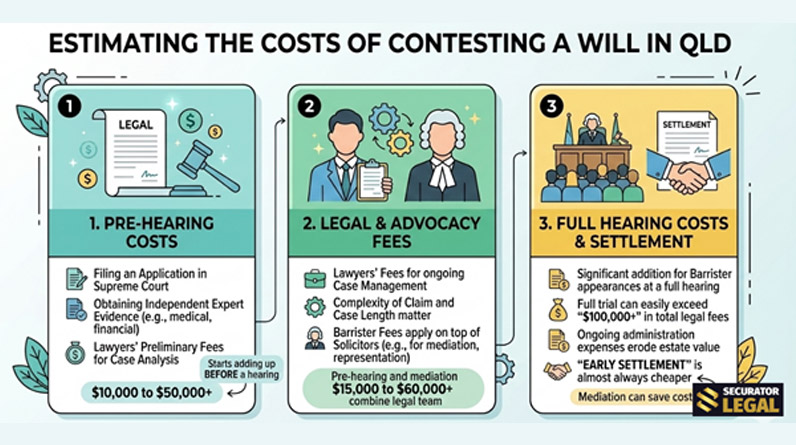
To give you a clearer picture, here are the main expenses claimants typically face:
- Legal Fees: Lawyers’ fees for contested estate proceedings in QLD typically range from $10,000 to $100,000 or more, depending on the complexity of the claim and how far it goes.
- Court Filing Fees: Filing an application in the Supreme Court carries its own set of fees that many claimants don’t account for until they’re already in the process.
- Expert Reports: In some contested cases, you may need independent expert evidence to support your claim, and each report adds to your total costs.
- Barrister Appearances: If your dispute proceeds to a hearing, barrister fees apply on top of your solicitor’s costs, and those can be substantial.
Early settlement almost always works out cheaper than running a full hearing, but that option isn’t always available, depending on the circumstances of the dispute.
Understanding Legal Costs and Who Pays Them
Legal costs in a will dispute don’t just come from your own solicitor. Depending on how your case resolves, you could end up responsible for the other side’s fees as well.
For your convenience, the table below breaks down who typically pays depending on how your case resolves:
| Outcome | Who Typically Pays |
| You win | The other party may be ordered to pay your costs, though this isn’t guaranteed |
| You lose | You will likely pay your own costs and possibly the other party’s as well |
| Case settles | Each party usually covers their own costs unless agreed otherwise |
Queensland courts follow the “costs follow the event” rule (in Queensland, this applies in both the Supreme Court and District Court), meaning the unsuccessful party generally bears the costs of proceedings.
A full adverse order can wipe out any financial benefit you stood to gain. That’s why you should seriously consider alternative dispute resolution, including mediation, before committing to litigation.
Once that’s established, it’s worth looking at what a failed family provision claim specifically means for you.
Family Provision Claims: What You Could Lose
A failed family provision claim rarely leaves you where you started. In many cases, you end up worse off than if you had never contested the will at all. Under the Succession Act 1981, eligible persons can apply for further provision from a deceased person’s estate, but that application comes with real financial exposure if unsuccessful.
The court will consider your financial need, your relationship with the testator, and the size of the estate. What often surprises applicants, though, is that conduct during the process carries just as much weight.
Courts pay close attention to how a claimant has behaved during negotiations, and refusing a reasonable settlement offer, for example, can directly influence any cost order made against you.
The Emotional and Relationship Consequences
The legal process might wrap up in 12 months, but the damage to family relationships can last far longer. Contesting a will puts people on opposite sides of a dispute, and that dynamic doesn’t always resolve once proceedings are over.
These are the consequences that rarely get discussed upfront:
- Family Relationships: Estate disputes frequently destroy relationships between siblings and other family members (some Brisbane families we’ve come across haven’t spoken in years after a contested estate).
- Time and Stress: Contested proceedings in QLD can run anywhere from 12 to 24 months, and the psychological toll of prolonged litigation is significant.
- Financial Drain: Ongoing legal costs during a drawn-out dispute add pressure that goes well beyond what most claimants anticipated.
The emotional toll of contesting a will often outlasts the legal process itself, and that’s worth factoring into your decision.
Is Challenging the Will Worth It?
Now that the costs and risks are laid out, the question becomes whether contesting makes sense for your situation. The honest answer is that some claims are worth pursuing and some simply aren’t, and a good solicitor will tell you which one you’re looking at.
Before committing to proceedings, weigh what you stand to gain against the full legal costs of getting there. A claim that looks promising can still carry significant financial risk if the estate is modest or the legal challenge is complex. Some disputes do settle quickly, but that outcome depends heavily on the circumstances.
Getting proper legal advice early gives you the clearest picture of your prospects, and that alone can save you from a costly decision.
🎬 That’s a wrap! Dive into more fresh content and join the vibe at SimpCity.